Jared Diamond argues in his book "Guns, Germs, and Steel", that the locations where agriculture- and (by his assertions) civilization- arose is largely determined by geographic placement. Implicit in his argument is the assertion that those cultures that could become agriculturalists, did become agriculturalists. This assumption is ambient in the language that Diamond uses, even as he denies it directly in the text. his language screams of the idea that civilization is chapter two in the story of humanity.
This addresses one of the central arguments that Daniel Quinn makes in his novel "Ishmael"- which is that civilization is not chapter two in a story to which hunter-gatherer tribes were chapter one.
Diamond asks, several times in the text- what stopped cultures with the same intelligence as other cultures from developing agriculture. Diamond further feels the need to prove that these non-agricultural cultures were in fact intelligent. What Diamond does not ask, is whether these people were happy with their way of life as hunter-gatherers and tribalists. Implicit in the questions Diamond asks and the questions he does not ask is the assumption that hunter-gatherers must subconsciously want to become agriculturalists.
This assumption runs counter to the historical primary records. Virtually wherever tribal peoples were encountered by civilized people, the tribal people resisted to the last ditch against becoming assimilated/conquered into a civilized way of life. Even those that were agriculturalists to a lesser or greater extent resisted the way of life on offer by civilized people.
And in fact, civilized people found themselves having to fight a rear guard action against defectors from their ranks joining the ranks of the tribalists. This phenomenon became so common that a name for it entered popular culture- going native.
In his novel Ishmael, Daniel Quinn points out that animals in captivity are naturally more inquisitive than those in the wild, because they can tell to a greater or lesser extent that something is wrong. And like a dog trying to scratch an itch, they begin to work at solving the problem. Quinn's argument is that progress is not some inevitable thing that humans should do or were meant to do, but something that the social inequality of civilization drove them to do, in an effort to ease the suffering their own way of life was causing them. Civilized cultures expanded and conquered the world using the tools their agriculture gave them in a desperate attempt to ease their own psychic suffering.
If you have not bought and read Ishmael yet, do so now.
Wednesday, September 3, 2014

Tuesday, September 2, 2014
Book Review: 'Ishmael' by Daniel Quinn Part One
I have worked at many jobs in my life, in large part due to my outright malice towards domesticated culture. Amongst the jobs that I have held is the job of book seller. Amongst the list of accomplishments from this job of which I am proud there is this: I have personally sold roughly 650 copies of Daniel Quinn's novel Ishmael in my three years as a book seller.
This book is the seed from which many open minds have sprouted, it is brilliant and life changing. So rather than give a single review of it, I am going to examine it in detail and extrapolate from it my conclusions and how this book relates to the Free Path.
let us begin.
This book is the seed from which many open minds have sprouted, it is brilliant and life changing. So rather than give a single review of it, I am going to examine it in detail and extrapolate from it my conclusions and how this book relates to the Free Path.
let us begin.
Teacher seeks Pupil
Must have an earnest desire to
save the world. Apply in person
That is the ad that begins the novel. That is where everything starts and where we shall start. This quote is on the back cover of the book, as well as on the second page of the first chapter. What does this say to you? Does it seem trite? Do you think the writer must be a charlatan? Are you intrigued? Are you daring to hope? The narrator is all of these things and more.
The ad explains several key things to us. The ad is not a fancy advertisment full of images and flashy type, just a simply classified ad. The ad is asking the reader to think big "earnest desire to save the world". The ad is about understanding something "Teacher seeks Pupil".
The sense of the ad is one of an outsider with a special knowledge, and strangely a knowledge that is not easy to give away. After all the teacher is advertising in the classifieds not in a full page ad, there is no heavy advertising budget behind this project.
It is an interesting idea- knowledge of how to save the world that is hard to give away. In James Redfield's "Celestine Prophecy", a shadowy vaguely governmental group is after the secret to stifle it. Here the secret is being given away and the teacher is evidently having difficulty doing so at all.
Why would it be hard to give away information on how to save the world? Perhaps for the same reason that is hard to give away information on how to lose weight- because the truth is unpopular and people will more readily buy an appealing lie rather than a stark truth?
And this is where Ishmael begins.
If you have not read and bought Ishmael you should do so now.
Monday, September 1, 2014
The Kilt, the Gho, and the Mohawk: Creating Cultural Identity
 The Kilt, the Gho and the Mohawk are all cultural touchstones to certain cultures, and interestingly all of them are artificial cultural constructs. The Mohawk is not the traditional hairstyle of the Mohawk peoples, but of the Pawnee. The Gho is the national garb of Bhutan, introduced by the government in a deliberate move to create a national style of dress. The Kilt as we know it today is the invention of an Englishman, and was a radical departure from the traditional Scottish article of clothing known today as the great kilt.
All of the these cultural items are artificial, some borrowed, some invented, some imported- but all have been embraced by the cultures and are now used to enforce strong cultural identity.
 The Gho can trace its roots back the to unification of Bhutan as a nation in the 17th century when a national dress was recommended by the Tibetan Lama Shabdrung Ngawang Namgyei in his proclamation the Driglam Namzha. The Gho as a required form of dress was formally instituted by the government 1989 to help foster national unity.
 The Kilt was originally a larger outfit from the 16th century called the Great Kilt that had a cloak portion that could be worn over the shoulder as a cloak or a hood. English Quaker Thomas Rawlinson invented the modern kilt in the 1720s and introduced it to Scottish workers who found the great kilt awkward for working in.
The Mohawk, as the hairstyle is currently thought of, was worn by the Omaha and the Pawnee rather than the Mohawk and the rest of the Iroquios Confederacy who wore a hairstyle which consisted of square of hair on the back of the crown of the head.
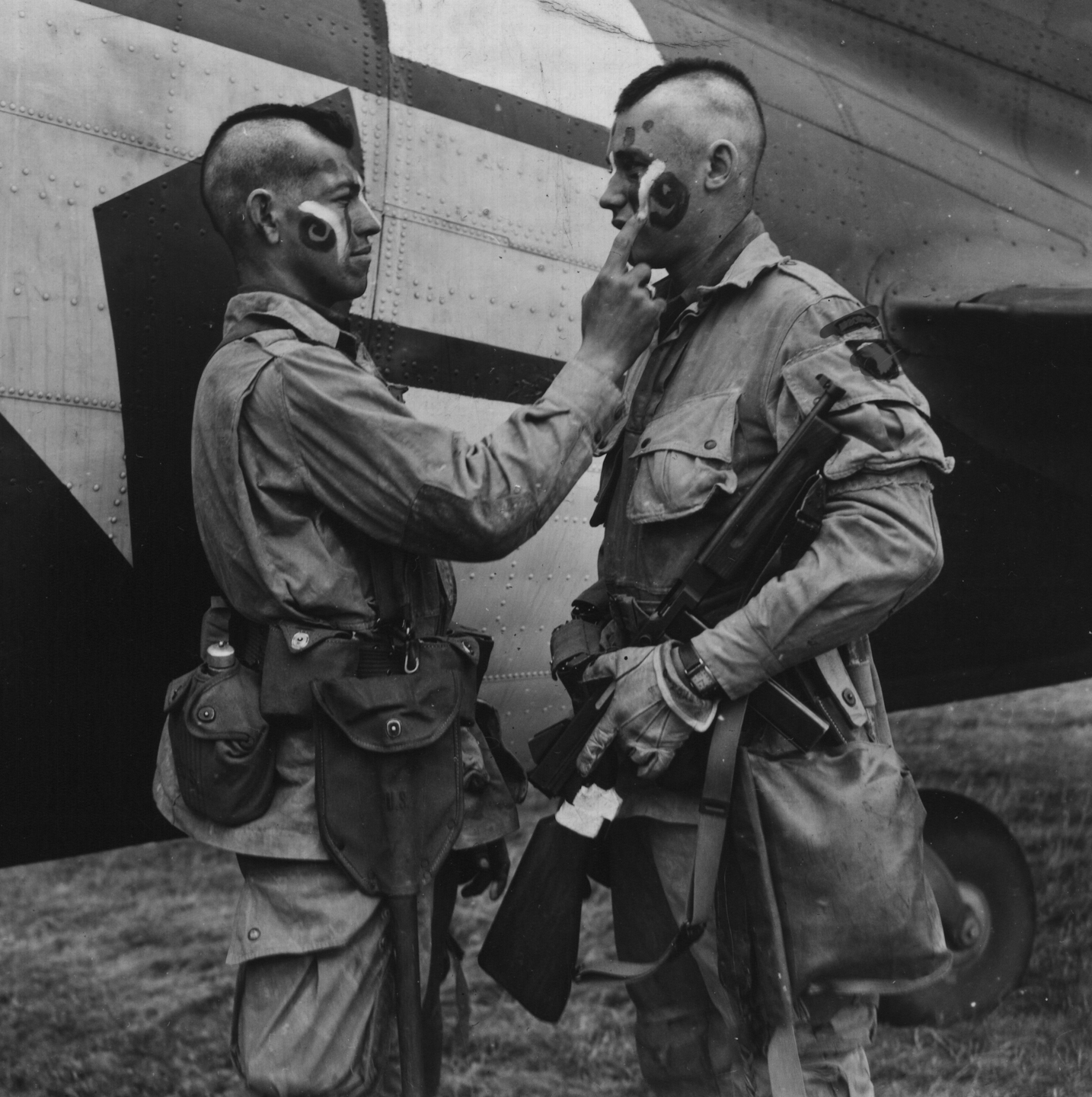
Nonetheless, all of these items have become cultural touchstones and icons of that culture. One adopted from neighboring people. One modified by a foreigner. One instituted the government on the people. And yet all of these have proven to have a powerful unifying effect on the culture. The French were appalled by the Eiffel Tower when it was first completed. Now the tower is a beloved national symbol.
Cultural landmarks and touchstones and ideas are critical to the identity of a culture and it doesn’t matter if the cultural point is borrowed, stolen, instituted, or enforced. However they are acquired, the cultural touchstones must be enforced and encouraged and enhanced.
This is how people become 'a people'.
They say, "We do this, different from other peoples, we do this. And this thing we do, these things we do, makes us who we are."
This is how people become 'a people'.
They say, "We do this, different from other peoples, we do this. And this thing we do, these things we do, makes us who we are."
Sunday, August 31, 2014
Subsitutes are Competitors

Industries are replaced, not by direct competition but by substitutes. As the song says "video killed the radio star", and computer killed typwriters, and mp3 players killed cds and also brick and mortar music stores.
In order to destroy a bad idea, we must make it obsolete.
Saturday, August 30, 2014
Food Preservation and Burying the Dead
Salt. Salting and drying and preservation in alcohol or vinegar have all been used to preserve food into the winter season prior to the advent of hot canning or freezing. Salt was also used to preserve Egyptian pharoahs, as was drying and so we see a strange connection between preserving food past the growing season, and preserving humans past their growing season.
The difference between traditional preservation of food and preservation of a human corpse is utility. The food will one day be eaten and thus its energy will be imparted back into the ecosystem. The preservation of a human being is an attempt to cheat decomposition, to stop time and to render humans immune to the laws of all other living things.
A simple law. All things that live do so by obtaining nutrients, and practically all of them other than green plants do so by eating. And everything that lives is, in turn, food for other living things.
When we preserve food we are not denying this truth. When we preserve our corpses we are attempting to pretend that we do not decay, that the worms do not have the right to feast upon us as they feast upon everyone else. We attempting to pretend that death does not exist.
Although one technology, food preservation, may have inspired the other; food preservation is a technology borne of a need to work with the facts of decomposition, whereas the preservation of a corpse is an act of war declared against biological law.
We are attempting to defy all of creation with our preservation of bodies after death. When I die, I wish my body to feed worms and flies and the living black earth itself with its microbes and bacteria. I wish to be the earth that my descendants walk and play upon. I wish to be the world in which unborn elders make their home.
The difference between traditional preservation of food and preservation of a human corpse is utility. The food will one day be eaten and thus its energy will be imparted back into the ecosystem. The preservation of a human being is an attempt to cheat decomposition, to stop time and to render humans immune to the laws of all other living things.
A simple law. All things that live do so by obtaining nutrients, and practically all of them other than green plants do so by eating. And everything that lives is, in turn, food for other living things.
When we preserve food we are not denying this truth. When we preserve our corpses we are attempting to pretend that we do not decay, that the worms do not have the right to feast upon us as they feast upon everyone else. We attempting to pretend that death does not exist.
Although one technology, food preservation, may have inspired the other; food preservation is a technology borne of a need to work with the facts of decomposition, whereas the preservation of a corpse is an act of war declared against biological law.
We are attempting to defy all of creation with our preservation of bodies after death. When I die, I wish my body to feed worms and flies and the living black earth itself with its microbes and bacteria. I wish to be the earth that my descendants walk and play upon. I wish to be the world in which unborn elders make their home.
Friday, August 29, 2014
Energy Input: The Hidden Price of Progress
I love my computer. But I think that I will be using something simpler in the future. I love my digital watch, but I am looking into a wind up pocket watch. I have a radio alarm clock, but also a wind up one. Why?
Energy Input.
I can wind a windup clock with a very nominal amount of elbow grease. My clock radio requires an electrical grid that would be outside my ability to create without the infrastructure of civilization.

How much of your life depends on systems that require magic energy imported through means you neither understand or control?
Energy Input.
I can wind a windup clock with a very nominal amount of elbow grease. My clock radio requires an electrical grid that would be outside my ability to create without the infrastructure of civilization.

How much of your life depends on systems that require magic energy imported through means you neither understand or control?
Thursday, August 28, 2014
Giant Kelp, Red Laver, Fish Eggs and Popcorn and Olduvai Theory

In the pacific Northwest, tribal cultures discovered a delicacy by combining the spawning practises of local fish with the Giant Kelp. Pacific Herring lay their eggs on the Giant kelp leaves and the local tribes would harvest the leaves, dry them and store them for the winter months. The spawn and kelp was normally then boiled and eaten with grease; and was considered a delicacy that had trade value to other tribes.
Red Laver was often pressed into 'cakes' or rolled into 'popcorn' and then dryed- sometimes after a brief fermentation period. Red Laver has also been used by traditional cultures to treat iodine deficiency. And like the Giant kelp can be served by boiling it with grease.

But this is practical information on how to live with your landbase. Such adhoc nutritional supplementation can be valuable to smaller agricultural communities. Tribes and homesteads and communes and ecovillages need not rely entirely upon what they grow and raise themselves. The important thing to consider here is the depth of the impact that your supplemental hunting or gathering can have on the landscape. How much do you take from the ecosystem? How much do you give back?
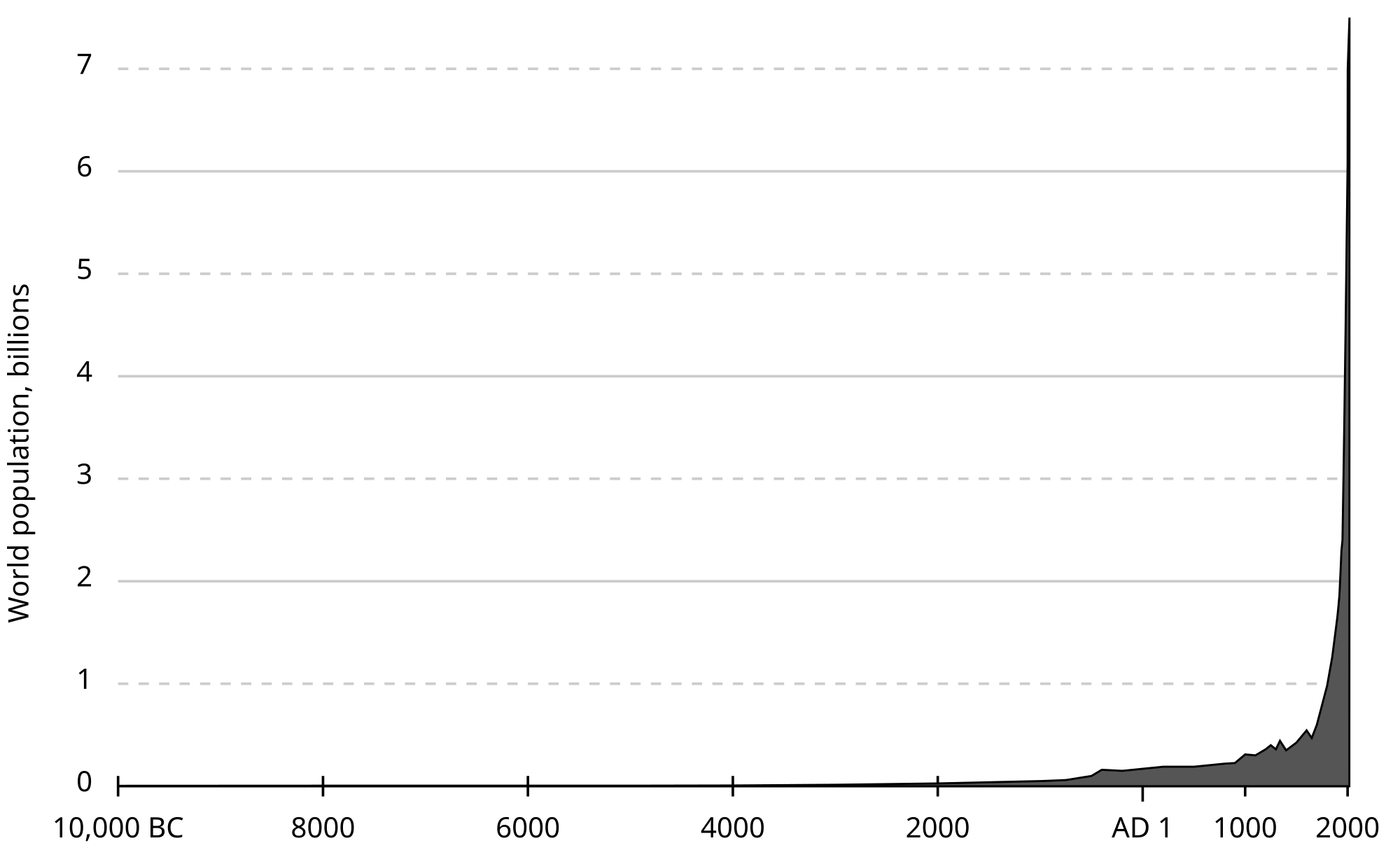 |
| World Population from 10,000 BC to Present |
 Much has been made of the fact that the modern world population could not be supported on small scale farming or hunting and gathering. This is true.
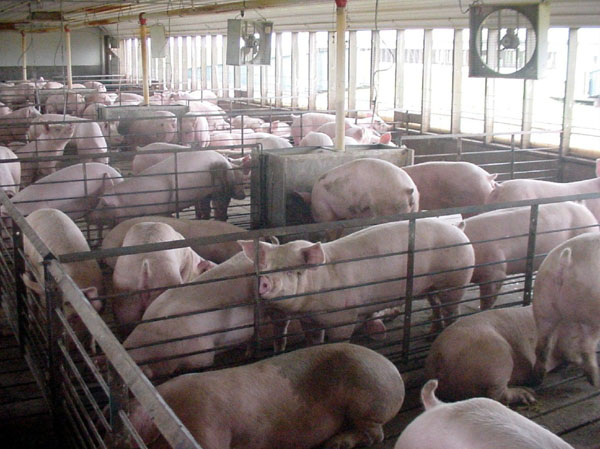
  Modern agriculture is wonder of technology, logistics, coordination, and overclocking just about every part of the system. Fertilizer allows farmers to avoid resting fields and to grow crops on other wise non arable land. Pesticides allows farmers to grow vast mono-cultures without having them decimated by insects like the potato bug. mechanization allows us to transport food from areas with cheaper labor, better land and longer growing seasons. Refridgeration increases the shelf life and transport time and distance food can be moved. Hormones grow animals faster for slaughter. An on and on and on. We have maximized the efficiency of our food delivery system. And any shift away from that will result in a drop in food production. And much has been made of that.
 Much less has been made of the fact that the modern world population cannot be supported on large scale farming without supplemental aid from fossil fuels in the form of pesticides, fertilizers, mechanization, transportation and reduced need for manpower.
 Short of discovering a magical new fuel that can be used as fuel, pesticide, and fertilizer; we are not going to be able to support a world population of this size for too much longer.
No species is immune to the laws that govern population size. A species that outstrips their food source will dwindle, often faster than they grew. As the locust swarm swells when it devours the savannah and then dies off en masse once the grass is gone, so to do other species who grow beyond the environments capacity to provide die of en masse until the numbers are low enough that the environment, itself likely now reduced, can support the numbers.
We should not be planning to feed the population we now support, we should be planning to feed the population that will be left when all is said and done. And we should be planning so that we are amongst those few that remain.
 This is of course morbid talk, and may be alarmist, and may even be wrong. There are ways that we could prevent catastrophe, perhaps turn a potential mass die off into a gentle slow decline. Working towards this gentle decline is noble work. However this noble work is being actively opposed by those gaining significant short term benefit from the current situtaion.
 The gentle decline cannot be achhieved without massive concerted change. On the other hand, small groups could conceivably remove their support of the current paradigm by moving to a small scale agricultural model or another more sustainable option.
Subscribe to:
Posts (Atom)