An Introduction to Interdimensional VIllainy

Monday, September 1, 2014

The Kilt, the Gho, and the Mohawk: Creating Cultural Identity

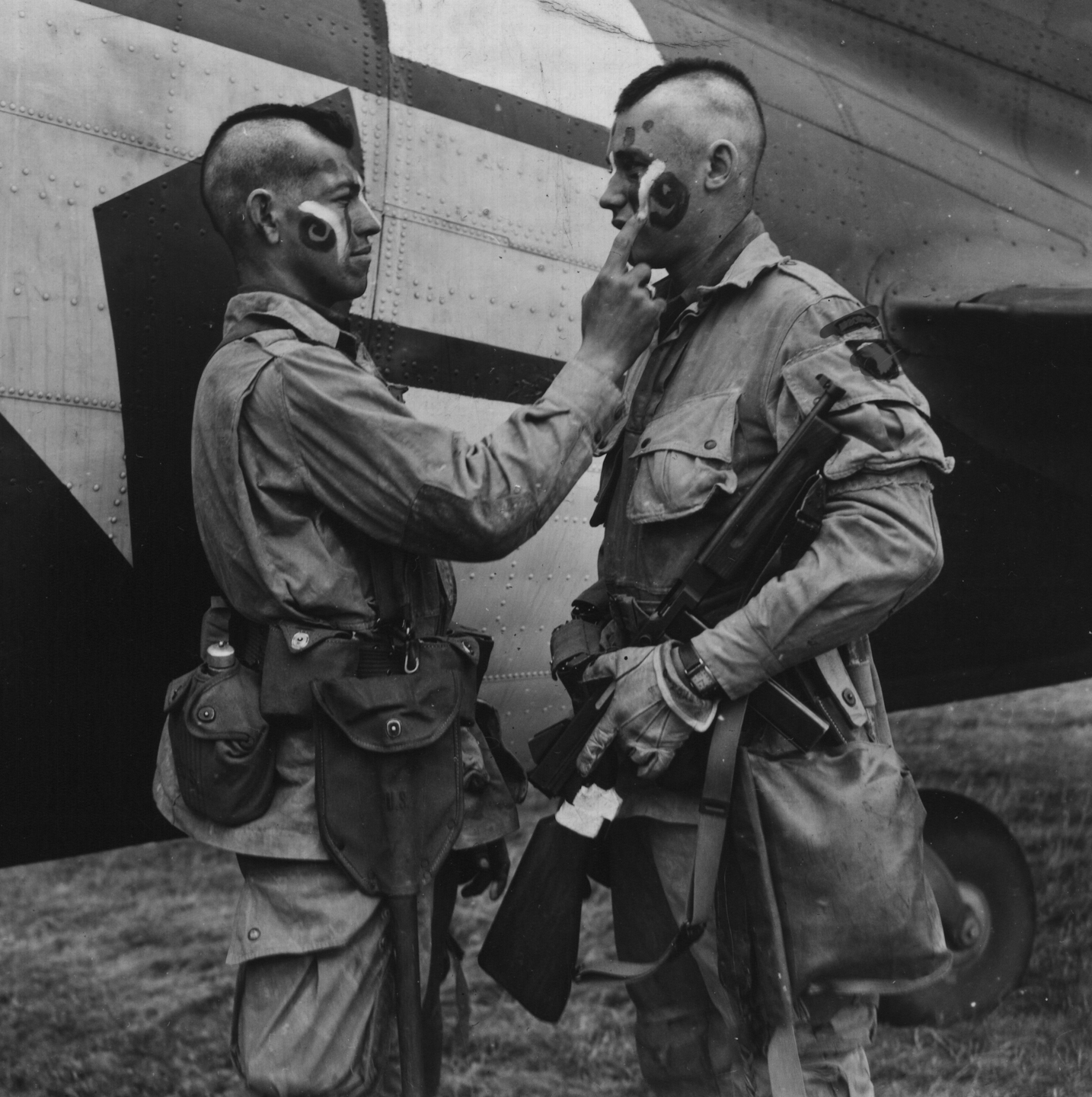
The Kilt, the Gho and the Mohawk are all cultural touchstones to certain cultures, and interestingly all of them are artificial cultural constructs. The Mohawk is not the traditional hairstyle of the Mohawk peoples, but of the Pawnee. The Gho is the national garb of Bhutan, introduced by the government in a deliberate move to create a national style of dress. The Kilt as we know it today is the invention of an Englishman, and was a radical departure from the traditional Scottish article of clothing known today as the great kilt.

All of the these cultural items are artificial, some borrowed, some invented, some imported- but all have been embraced by the cultures and are now used to enforce strong cultural identity.

The Gho can trace its roots back the to unification of Bhutan as a nation in the 17th century when a national dress was recommended by the Tibetan Lama Shabdrung Ngawang Namgyei in his proclamation the Driglam Namzha. The Gho as a required form of dress was formally instituted by the government 1989 to help foster national unity.
The Kilt was originally a larger outfit from the 16th century called the Great Kilt that had a cloak portion that could be worn over the shoulder as a cloak or a hood. English Quaker Thomas Rawlinson invented the modern kilt in the 1720s and introduced it to Scottish workers who found the great kilt awkward for working in.

The Mohawk, as the hairstyle is currently thought of,  was worn by the Omaha and the Pawnee rather than the Mohawk and the rest of the Iroquios Confederacy who wore a hairstyle which consisted of square of hair on the back of the crown of the head.

Nonetheless, all of these items have become cultural touchstones and icons of that culture. One adopted from neighboring people. One modified by a foreigner. One instituted the government on the people. And yet all of these have proven to have a powerful unifying effect on the culture. The French were appalled by the Eiffel Tower when it was first completed. Now the tower is a beloved national symbol.

Cultural landmarks and touchstones and ideas are critical to the identity of a culture and it doesn’t matter if the cultural point is borrowed, stolen, instituted, or enforced. However they are acquired, the cultural touchstones must be enforced and encouraged and enhanced.

This is how people become 'a people'.

They say, "We do this, different from other peoples, we do this. And this thing we do, these things we do, makes us who we are."

Sunday, August 31, 2014

Subsitutes are Competitors

Things that can replace you, compete with you as effectively as- often more effectively than- your direct competitors.

Industries are replaced, not by direct competition but by substitutes. As the song says "video killed the radio star", and computer killed typwriters, and mp3 players killed cds and also brick and mortar music stores. 

In order to destroy a bad idea, we must make it obsolete.

Saturday, August 30, 2014

Food Preservation and Burying the Dead

Salt. Salting and drying and preservation in alcohol or vinegar have all been used to preserve food into the winter season prior to the advent of hot canning or freezing.  Salt was also used to preserve Egyptian pharoahs, as was drying and so we see a strange connection between preserving food past the growing season, and preserving humans past their growing season.

The difference between traditional preservation of food and preservation of a human corpse is utility. The food will one day be eaten and thus its energy will be imparted back into the ecosystem. The preservation of a human being is an attempt to cheat decomposition, to stop time and to render humans immune to the laws of all other living things.

A simple law. All things that live do so by obtaining nutrients, and practically all of them other than green plants do so by eating. And everything that lives is, in turn, food for other living things.

When we preserve food we are not denying this truth. When we preserve our corpses we are attempting to pretend that we do not decay, that the worms do not have the right to feast upon us as they feast upon everyone else. We attempting to pretend that death does not exist.

Although one technology, food preservation, may have inspired the other; food preservation is a technology borne of a need to work with the facts of decomposition, whereas the preservation of a corpse is an act of war declared against biological law.

We are attempting to defy all of creation with our preservation of bodies after death. When I die, I wish my body to feed worms and flies and the living black earth itself with its microbes and bacteria. I wish to be the earth that my descendants walk and play upon. I wish to be the world in which unborn elders make their home.

Friday, August 29, 2014

Energy Input: The Hidden Price of Progress

I love my computer. But I think that I will be using something simpler in the future. I love my digital watch, but I am looking into a wind up pocket watch. I have a radio alarm clock, but also a wind up one. Why?

Energy Input.

I can wind a windup clock with a very nominal amount of elbow grease. My clock radio requires an electrical grid that would be outside my ability to create without the infrastructure of civilization.


How much of your life depends on systems that require magic energy imported through means you neither understand or control?

Thursday, August 28, 2014

Giant Kelp, Red Laver, Fish Eggs and Popcorn and Olduvai Theory

In the Pacific Northwest, Giant Kelp and Red Laver are two species of edible seaweed that have been used historically as foods by the Native Americans living here. Red laver is eaten in some form or another in practically every culture that has access to it. And seaweed have been used as food all over the world as far back as pre-historic times.

In the pacific Northwest, tribal cultures discovered a delicacy by combining the spawning practises of local fish with the Giant Kelp. Pacific Herring lay their eggs on the Giant kelp leaves and the local tribes would harvest the leaves, dry them and store them for the winter months. The spawn and kelp was normally then boiled and eaten with grease; and was considered a delicacy that had trade value to other tribes.

Red Laver was often pressed into 'cakes' or rolled into 'popcorn' and then dryed- sometimes after a brief fermentation period. Red Laver has also been used by traditional cultures to treat iodine deficiency. And like the Giant kelp can be served by boiling it with grease.

This is interesting information, but most people might fail to see a point in adding this to their brain. There are other things to learn like walkthroughs of HALO and cocktail mixes and Sports statistics and music and movies and celebrity scandals.

But this is practical information on how to live with your landbase. Such adhoc nutritional supplementation can be valuable to smaller agricultural communities. Tribes and homesteads and communes and ecovillages need not rely entirely upon what they grow and raise themselves. The important thing to consider here is the depth of the impact that your supplemental hunting or gathering can have on the landscape. How much do you take from the ecosystem? How much do you give back?
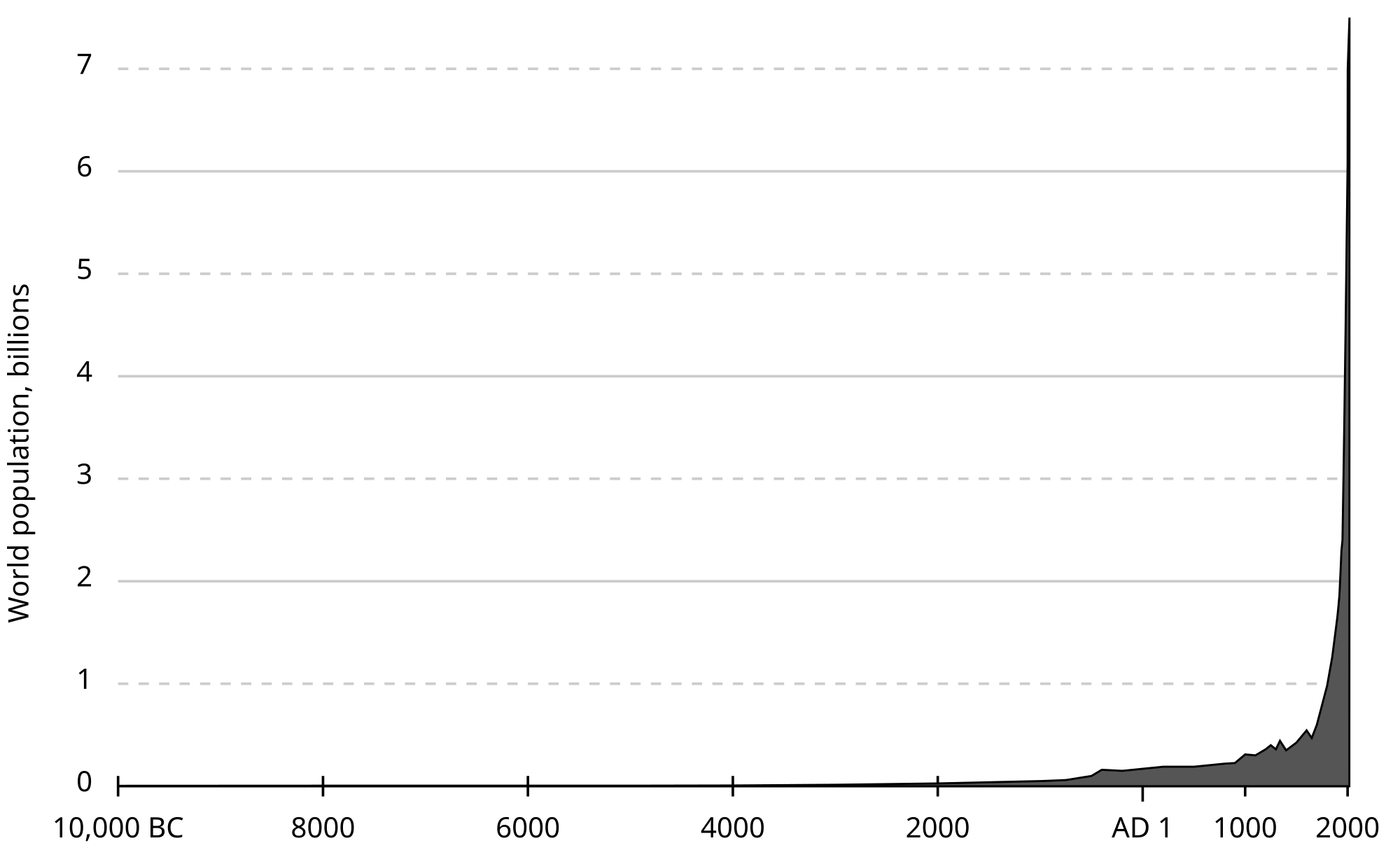
World Population from 10,000 BC to Present
Much has been made of the fact that the modern world population could not be supported on small scale farming or hunting and gathering. This is true. 

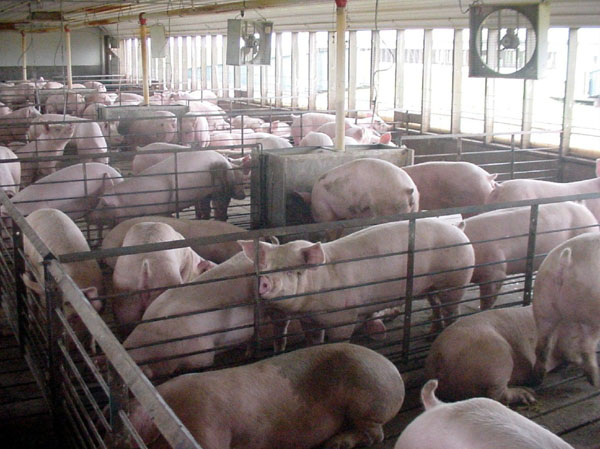
Modern agriculture is wonder of technology, logistics, coordination, and overclocking just about every part of the system. Fertilizer allows farmers to avoid resting fields and to grow crops on other wise non arable land. Pesticides allows farmers to grow vast mono-cultures without having them decimated by insects like the potato bug. mechanization allows us to transport food from areas with cheaper labor, better land and longer growing seasons. Refridgeration increases the shelf life and transport time and distance food can be moved. Hormones grow animals faster for slaughter. An on and on and on. We have maximized the efficiency of our food delivery system. And any shift away from that will result in a drop in food production. And much has been made of that.

Much less has been made of the fact that the modern world population cannot be supported on large scale farming without supplemental aid from fossil fuels in the form of pesticides, fertilizers, mechanization, transportation and reduced need for manpower.

Short of discovering a magical new fuel that can be used as fuel, pesticide, and fertilizer; we are not going to be able to support a world population of this size for too much longer.

No species is immune to the laws that govern population size. A species that outstrips their food source will dwindle, often faster than they grew. As the locust swarm swells when it devours the savannah and then dies off en masse once the grass is gone, so to do other species who grow beyond the environments capacity to provide die of en masse until the numbers are low enough that the environment, itself likely now reduced, can support the numbers.

We should not be planning to feed the population we now support, we should be planning to feed the population that will be left when all is said and done. And we should be planning so that we are amongst those few that remain.

This is of course morbid talk, and may be alarmist, and may even be wrong. There are ways that we could prevent catastrophe, perhaps turn a potential mass die off into a gentle slow decline. Working towards this gentle decline is noble work. However this noble work is being actively opposed by those gaining significant short term benefit from the current situtaion.

The gentle decline cannot be achhieved without massive concerted change. On the other hand, small groups could conceivably remove their support of the current paradigm by moving to a small scale agricultural model or another more sustainable option.

Wednesday, August 27, 2014

Emo Teens and Something Fishy

We can look and still not see. We can listen and hear nothing. Why then are there no comparative words for smell and taste and touch? Do we value these other senses so little? Is this because visual and auditory messages are the primary methods of human communication? If we communicated more be smell like a wolf or dog, would we have a word for investigation by smell?


And what about sniff? Can we sniff, and smell nothing? Is feel the touch equivalent? Can we touch, but not feel?


Perhaps then the words exist, but we do not value them. Perhaps we have become smell and touch atrophied. Perhaps those senses have fallen out of use in a world of televisions and phones and computer screens- devices designed to serve only two senses.


There are problems, of course. I can imagine that smell-o-vision is not a good enhancement to television or movies.


Perhaps then, the problem is progress. Perhaps, once again, I must recommend that we immerse ourselves in the world to re-familiarize ourselves with the living black earth and the rich teeming world it supports. We are the emo teenager of Planet Earth. Hiding in our bedrooms listening to angsty music.


Perhaps we need somebody to kick us off the couch and tell us to play outside in the mud.

Tuesday, August 26, 2014

Pay Day Loans

We, as a civilization, are paying our grocery bills with payday loans. We are buying our furniture with nothing down for the first six months, even though we don't have the money to make even that first down payment.  We are paying our rent with our credit cards, and living well beyond our salary's ability to pay. We can't afford all the child we have, and our wife is pregnant again. We are the yuppy white trash of civilizations. And we are in serious trouble.

Oil is a non renewable resource. Because we use a lot of oil, we are able to grow exponentially in our production and construction. As we grow, we need every greater amounts of oil.

Population is a function of food availability and space availability. Given enough of both, population will grow until it reaches the new limits of both.

If we use 10 liters of oil to double our food production, we will then double our population to match the new limit imposed by the increased food production. We must then use more oil to feed the new normal and even more if we wish to grow again next year.

Since we define success as growth, we will seek growth. And whether that growth is population or economic, we will still require more oil to fund the growth.

Constant growth based on a finite source is automatically unsustainable. The fact that our society can no longer survive without that finite energy source does not change that reality and is not a valid counter argument, but is in fact a dire warning that success may not be a valid option any longer.

If we have a pile of 100 1 dollar bill, and if on the first day we take 4 dollars, and every day we take 25% more from the pile. On the first day the pile has $96 left. On the second day we take $5 and the pile has $91. On the Third day we take $6 and the pile has $85. If we continue to round down, then on the fourth day we remove $7 and have $78. On the fifth day we then remove $8 and we have $70 in the pile. On the sixth day we remove $10 and have $60 left in the pile. On the seventh day we remove $12, and we have $48 left in the pile. On the eighth day we remove $15 and have $33 left in the pile. On the ninth day we then remove $18 and have only $15 left in the pile. We are now supposed to remove $22, but there is only $15 left in the pile. And on the tenth day we owe the pile $7 dollars.

If we have on a finite amount of stuff then constant increases, no matter how reasonable, will always be unsustainable.

We can also note that the Peak of the money pile, that is the point where we had used up half the money, was on day seven. Despite half the money being left, we only had two days left where we able to withdraw the full amount needed. While we were only half way through the money, we were 70% of the way through our time with access to that money.

If we increase how much we use every year, then the peak of supply will naturally occur- not at the halfway point with regards to the time where we may use the supply- but significantly closer to the end of the period when we may make use of the supply.

"There would be no surplus if EROEI approaches 1:1. What Hall showed is that the real cutoff is well above that, estimated to be 3:1 to sustain the essential overhead energy costs of a modern society. Part of the mental equation is that the EROEI of our generally preferred energy source, petroleum, has fallen in the past century from 100:1 to the range of 10:1 with clear evidence that the natural depletion curves all are downward decay curves. An EROEI of more than ~3, then, is what appears necessary to provide the energy for socially important tasks, such as maintaining government, legal and financial institutions, a transportation infrastructure, manufacturing, building construction and maintenance and the life styles of the rich and poor that a society depends on.

The EROEI figure also affects the number of people needed for food production. In the pre-modern world, it was often the case that 80% of the population was employed in agriculture to feed a population of 100%, with a low energy budget. In modern times, the use of cheap fossil fuels with an exceedingly high EROEI enabled 100% of the population to be fed with only 4% of the population employed in agriculture. Diminishing EROEI making fuel more expensive relative to other things may require food to be produced using less energy, and so increases the number of people employed in food production again." - from wikipedia

EROI is the energy return on investment, and this is the other side of the problem. All energy, such as oil, is not created equal. The early oil, such as Texas sweet crude that bubbles up from the soil like in the Beverly Hillbillies was found first and use first, because it was easy to get at. As a result, the amount of energy put in was small compared to the energy received.

But ass time goes by, we run out of Texas crud. USA oil production peaked in the 70s. And so we go looking for more oil. And a lot of it is in politically unstable countries, where we have to spend a lot of money to get the oil from the area to where we want to use it. And a lot of it is trapped under miles of ocean and ocean floor requiring difficult and delicate operations with crude and enormous machinery to extract for even more money and effort. And a lot of it is trapped in tar and oil shale where the amount of energy required to obtain the oil is sometimes as much or more than the amount that is received.

Just like scraping the last peanut butter from the corners of the jar on the Monday morning when you're running late, finding oil after the easy stuff is gone is a pain in the neck. And, even if there is oil left, we may not have the energy available or economic incentives strong enough to extract it.

There is a legend, related in the movie "Rush Hour 2" of a great Red Dragon that lived in a cave and demanded that the locals bring gold to it. The treasure eventually blocked the exit and the dragon could not leave the cave and thus starved.

In other words, our time is almost up.