You create with clay, not with sky. Past the sky is the void of space. Why are you looking to the void to find your inspirations and your gods?
Remember your connection to clay that made you, the clay to which your ancestors returned. You are made from the grave dust of a thousand generations before yours. You are a short span of time that eats through life and then is in turn eaten.
A creature of earth, who are tied to the ground you live upon and supported by it. Fear for the future when you eat from the land of another without giving earth back to that land in thanks. This is unsustainable, the center does not hold.
Give thanks to the Earth. Give thanks to Ancestors. Pray to your descendants- to our unborn elders- for you will leave the world to them one day. Death is the return to earth, the becoming of earth that will nourish your descendants. Give yourself willingly to the soil and protect the soil and the health of the soil- for when you do, you protect both your ancestors: who are in the soil, and your descendants: who will be raised by the soil.
The soil is a fortune teller than tells us the future of those who live upon it. The soil is a records keeper that tells the history of those who lived upon it in days past. To take from the soil and not give back, to overwork the soil and not re-nourish it, these things are crimes against tomorrow's children.
Death is not the end of time on earth, not a cutting short. Death is a return to the earth so that you can do your part for the next generation. Death is an accounting for how you have treated the land you lived on. Do not die within a box, leave your nutrients to the earth. If you do this, the earth will feed your children and their children and on into generations unseen.
In the clay beneath your feet will you create your legacy. From the clay beneath your feet will you be judged by your descendants.
Showing posts with label culture. Show all posts
Showing posts with label culture. Show all posts
Saturday, December 27, 2014

Monday, October 13, 2014
Monday Meditations: What is the fear that drives domesticated man?
What is the fear that drives domesticated man? Where does his terror lie? What drives him to lock his dead away from their nurturing mother in the final sleep? What drives him to coat the comfortable ground with stone and steel until the earth sleeps so far below that it cannot be felt? What drives him to insulate himself within buildings so much larger than are needed? What drives him to interact with the world and with other domesticated humans through ever more convoluted intermediaries?
(domesticate man can safely be referred to as male- for his politics explicitly marginalize the female as well as the minority and the servant and the slave)
Let us examine the words in common across differing views. Lets us look for the assumptions not questioned, but held by all.
"That he may have dominion over . . . every creature."
Genesis 1:26
"There is not, within the wide range of philosophical inquiry, a subject more intensely interesting to all who thirst for knowledge, than the precise nature of that important mental superiority which elevates the human being above the brute, and enables man alone to assume the sway wheresoever he plants his dwelling; and to induce changes in the constitution and adaptions (sic) of other species, which have no parallel where his interference is unknown."
by Edward Blyth
(The Magazine of Natural History Vol. 10. 1837)
"If it can be shown possible for man to have descended or ascended from the lower animals, it will require enormous additional evidence to show that such descent is probable; and still much more to make it certain. "
by Rev William A. William
"Homo heidelbergensis was developing a complex mind - once this boundary had been reached, there was no turning back."
"The more disciplined behavior (behavior determined by intellect) displayed by the individual, the more human he becomes. The less disciplined behavior (behavior in response to instinct) displayed by an individual, the more he becomes like the lower order animals that are lacking in intellect and are driven by their instincts. "
The assumptions should be clear.
Domesticated man does not consider himself an animal. Or, if forced to admit that indeed he is an animal in the technical sense, then domesticated man maintains that he is so different- so above- other animals so as to render the argument moot.
I would like to use a different quote to draw attention to the second assumption in the above quotations.
"It is an important and popular fact that things are not always what they seem. For instance, on the planet Earth, man had always assumed that he was more intelligent than dolphins because he had achieved so much - the wheel, New York, wars and so on - whilst all the dolphins had ever done was muck about in the water having a good time. But conversely, the dolphins had always believed that they were far more intelligent than man - for precisely the same reasons."
Why is domesticated man afraid of being an animal? Why is domesticated man so driven to enforce his conception of order upon an already perfectly functioning and ordered world? What does this have to do with domesticated man's need to hide from the world he is seeking to re-order in his own image?
So many questions. So much fear.
Tuesday, October 7, 2014
From Fakelore to Makelore (Fixing a Stolen Term)
Fakelore refers to invent folklore, but in a way that presumes that inventing folklore is somehow unusual or spurious. Makelore is the same idea, but understands that all folklore is invented and serves a social cultural purpose and created.
http://en.wikipedia.org/wiki/Fakelore
Makelore is incredibly important to memory and story and we should build our own personal and shared makelore in order to remember the stories that tell us who we are and who we want to be.
http://en.wikipedia.org/wiki/Fakelore
Makelore is incredibly important to memory and story and we should build our own personal and shared makelore in order to remember the stories that tell us who we are and who we want to be.
Monday, October 6, 2014
Monday Meditations: Rotting Life and Decomposition Phobia
The domesticated human is afraid of death and more precisely- afraid of decomposition. Dead human bodies are sealed in boxes before they are allowed to enter the earth, safe now from every remixing with the land that birthed and sustained them, safe now from ever returning and being part of the next cycle of life. The domesticated human removes themselves from the landscape, from the eco-system. They take food, they take air and they take in minerals and nutrients, but never return them- as is the bargain life makes with itself.
The domesticated human is a thief and a parasite. The domesticated humans takes and takes and does not give back. So the question arises- why not?
The domesticated human is afraid to die, afraid to rot, afraid to give back, afraid to return. Do they fear retribution, angry vengeance from the rest of the earthy community if they allow their body and perhaps their spirit to rejoin the earth from which it was composed?
Do they fear something else?
Do they fear many other things?
Tuesday, September 30, 2014
Old Word Repurposed: Warrior
Warrior is an ambiguous term to most people.
But then so is adult. People become adults by trudging through time one second at a time, and accumulate additional privileges through no achievement or effort in most cases (earning a driver's license and graduating high school are the most arduous things that people must do to acquire the traditional trappings of adulthood).
You can become an adult in the modern world so easily that term is meaningless. Warrior is something that you become by doing something. Like being an athlete or a writer or a scientist or a scholar; being a warrior implies a doing in the word itself. If you claim to be an athlete, but look like Homer Simpson people will rightly question your claim. But to claim to be an adult, one need merely get older and have a piece of ID if you wish to enter a bar.
We use Warrior not to mean one who is violent, but one who is ready to face the world: capable of critical thought, able to be self-sufficient, and able to defend their self against opposing forces.
Monday, September 29, 2014
Monday Meditations: On Pacifism
I would only have to write this to a domesticated populace. Attack a bear at your peril- it WILL retaliate. Watch small children, if one transgresses the other- the injured party will inevitably respond. Watch the social life of wolves or chicken, the pecking order is not a metaphor.
Only the modern human is so domesticated, self-defense having become so alien, that not fighting back in the face of violence could be touted as a virtue.
Even the loyal and humble dog will snap at an abuser. Humans have domesticated animals precisely by breeding for docility, and in doing so the effectively breed out the ability for these animals to survive without human intervention.
What then, does that say about us and how those in power have shaped our modern domesticated human tendencies? If upset, we protest. That is to say, we beg those who have wronged us and ask that they make things better.
Violence is power, and the threat of violence is power. The rightness of the ability to meet oncoming violence with defensive violence is what underlies the laws allowing self-defense. Likewise the rightness of meeting oncoming violence with violence is what anyone who intervenes in an assault or a rape invokes. This is why they are lauded as heroes.
What does it say about us, when we vilify all uses of violence- including righteous ones? What does it say about the imbalance of power when we live in a society where the right violence is implicitly or explicitly granted to one group and not another? What do these things tell us about society?
Virtually every aristocracy in history has tried to limit the underclasses access to the means of violence. Swords or spears may only be wielded by certain groups. Certain elite are explicitly allowed to kill underclass members for any perceived slight. This imbalance is not an accident.
Some readers may be put off by my use of the word violence in a positive manner, rather than using a more polite and acceptable word like self-defense. Violence is a means of self-defense, as is charm, as is running, as is psychology and bribery, and so on. Self-defense is safely vague and politely allows the meek to talk around or about violence without ever having to address the honest nature of violence. This choice of words, unless used to include the whole array of self-defense possibilities, is cowardly.
And of course cowardice is good, meekness in the flock makes the sheep dog's duties easier- those chosen few allowed to wield the sword. But you only need a few sheepdogs. After all, you don't want sheep with sharp teeth in your flock.
Wednesday, September 24, 2014
The Future
I want to talk to you today and I want to let you know that you are the most important generation in history. And that because of that, history will remember people like you and me as history's greatest villains. The world is in danger on multiple levels.
The evidence has been obvious for years. But only now are people starting to accept the evidence in large numbers. As a result, this generation- you and I will be blamed for the collapse that is likely coming. This is not fair, but this is how it is.
The previous generation- your parents and mine- will claim ignorance. They will say that the signs weren't clear. They are lying, of course, to save their guilty souls. The signs were clear. Our parents simply stuck their heads into the sand and passed the buck to us. Well, unfortunately for us- the buck seems to have stopped here. Our parents are busy playing denial or pass the blame or both. So we are all that's left.
And based on our performance so far- history will remember us as villains and cowards- as world breakers. In the time it has taken to say this. Another species is likely extinct, 15 will be extinct by the end of this hour, over 300 by the end of the day. Between 300 and 600 acres of rain forest will have been deforested permanently. Almost 300 people will have been born, onto a planet whose population has gone from 1.5 billion to 6.7 billion is roughly 100 years.
Species extinction, deforestation and associated ecosystem destruction, overpopulation.
Why do we allow this?
Because its too big? Because we need to make a living? Because we have bills to pay and assignments to hand in? Because time spent saving the world means an F in biology or not paying the cable bill?
How dare we.
A Formal Objection
The paragraph above exemplifies nearly everything destructive and self-defeating about our civilization. It articulates near perfectly almost the whole of the Industrialized Nation's philosophy.
Let us start with this passage. It is, just to start, patently untrue. This statement implies that the natural world lies in disorder without us civilized humans. That the water cycle, and erosion and plate tectonics are disordered and without pattern. That natural selection and macro-evolution are just random events. That ecosystems are simply random collections of animals and plants. The ignorance in this statement is simply astounding.
The second half of the sentence is even worse however.
Tribal cultures have an incredible level of order- just to limit ourselves to humans for the moment. Pretending that there is a higher level of complexity in civilized society fails to take into account all the myriad of nuances of tribal society.
Beyond human affairs however, the passage says implicitly and explicitly that what civilized humans make is more complex than a leaf of lettuce or a grain of millet and the accompanying plant that produced it, and the accompanying ecosystem, food web/food chain that made that plant possible- tying together thousands of species and even more apparently inanimate forces such as the wind and the nitrogen cycle.
The arrogance in this statement, arrogance that is left as a premise and not even examined by its author, is almost beyond belief. Or at least, the arrogance would be beyond belief if it did not come from a culture with a ten thousand year history of such arrogance.
The next sentence is not as bad, but it has within it one of the key miss-assumptions of civilized humanity.
By assuming that the world is harsh, everything becomes an enemy or an attack. This basic belief in a hostile wilderness (the wilderness itself being an invention of civilized humanity) is what allows us to drive all species before us and destroy them whenever they resist or simply stand in the way of our expansion.
This statement is partially true on the surface. Such societies are rarely more adaptive and just as rarely better at solving problems. They don't need to be either, because they can simply pour energy into the problem. Much in the way a rich person can simply spend money to make most problems go away.
And this does not make the rich person more adaptive. They pay other people to be adaptive. All of this does make the society more resilient however- at least temporarily. The weakness of this statement is that such societies are thus dependent upon a mass of cheap and readily available energy.
In other words, such societies are addicted to energy. They are slaves to cheap fuel and act like junkies when they need another 'hit' of cheap energy to keep their economies and the accompanying systems running.
Another Path?
Instead of looking at the world around us as both a dangerous wild place and also as a giant piggy bank we can take as much from as we like, we should instead look at the world as a partner.
The world is not alien. We have made ourselves very alien, but the earth is not alien at all. The earth is our home and our parent and our partner in our continued existence.
We need to treat it like an equal. Take what we need, but never again become so gluttonously greedy. Give back to the earth when we take from it. Treat it, and by association ourselves and our children, with respect.
This lifestyle will necessitate adaptive cultures, and resilient cultures, because your become more capable and adaptive and resilient when you cannot simply throw money/energy at a problem and attempt to over power it. In such cases you must be creative and capable and - obviously- better at solving problems.
Our problem is that all that -very limited- high energy fuel has made us very lazy; and wealth has taken the place of ingenuity. We need to regain our ingenuity and our resilience. And that starts with changing our premises.
The earth is not a wilderness, full of disorder and dangers. It is our home and our workshop and out school. We do not need more energy to be more adaptive and resilient. We need more ingenuity, more mental flexibility and more competence to be adaptive and resilient.
We need to seek enough, not more. We need to work with our partners on this planet- the animals, the green plants, the fungi, the bacteria. We have been at war with 1.5 million species, as well as the ecosystem that makes our continued survival possible, and it is a war we cannot win.
We need a whole new world view, and we need it now.
The evidence has been obvious for years. But only now are people starting to accept the evidence in large numbers. As a result, this generation- you and I will be blamed for the collapse that is likely coming. This is not fair, but this is how it is.
The previous generation- your parents and mine- will claim ignorance. They will say that the signs weren't clear. They are lying, of course, to save their guilty souls. The signs were clear. Our parents simply stuck their heads into the sand and passed the buck to us. Well, unfortunately for us- the buck seems to have stopped here. Our parents are busy playing denial or pass the blame or both. So we are all that's left.
And based on our performance so far- history will remember us as villains and cowards- as world breakers. In the time it has taken to say this. Another species is likely extinct, 15 will be extinct by the end of this hour, over 300 by the end of the day. Between 300 and 600 acres of rain forest will have been deforested permanently. Almost 300 people will have been born, onto a planet whose population has gone from 1.5 billion to 6.7 billion is roughly 100 years.
Species extinction, deforestation and associated ecosystem destruction, overpopulation.
Why do we allow this?
Because its too big? Because we need to make a living? Because we have bills to pay and assignments to hand in? Because time spent saving the world means an F in biology or not paying the cable bill?
How dare we.
"Of Course, these are critical services, but energy's role in our lives is actually more fundamental, essential, and subtle. We extract energy from our environment to create order out of disorder and complexity out of simplicity. Put simply, societies with access to lots of energy are generally more adaptive, resilient, and better at solving problems."
(The Upside of Down, by Thomas Homer-Dixon, page 37)
A Formal Objection
The paragraph above exemplifies nearly everything destructive and self-defeating about our civilization. It articulates near perfectly almost the whole of the Industrialized Nation's philosophy.
"We extract energy from our environment to create order out of disorder..."
Let us start with this passage. It is, just to start, patently untrue. This statement implies that the natural world lies in disorder without us civilized humans. That the water cycle, and erosion and plate tectonics are disordered and without pattern. That natural selection and macro-evolution are just random events. That ecosystems are simply random collections of animals and plants. The ignorance in this statement is simply astounding.
The second half of the sentence is even worse however.
"...and complexity out of simplicity."
Tribal cultures have an incredible level of order- just to limit ourselves to humans for the moment. Pretending that there is a higher level of complexity in civilized society fails to take into account all the myriad of nuances of tribal society.
Beyond human affairs however, the passage says implicitly and explicitly that what civilized humans make is more complex than a leaf of lettuce or a grain of millet and the accompanying plant that produced it, and the accompanying ecosystem, food web/food chain that made that plant possible- tying together thousands of species and even more apparently inanimate forces such as the wind and the nitrogen cycle.
The arrogance in this statement, arrogance that is left as a premise and not even examined by its author, is almost beyond belief. Or at least, the arrogance would be beyond belief if it did not come from a culture with a ten thousand year history of such arrogance.
The next sentence is not as bad, but it has within it one of the key miss-assumptions of civilized humanity.
"We often use this order and complexity, in turn, to help us solve the problems we face- for instance, to shelter ourselves from our harsh environment and to protect ourselves from attack."
By assuming that the world is harsh, everything becomes an enemy or an attack. This basic belief in a hostile wilderness (the wilderness itself being an invention of civilized humanity) is what allows us to drive all species before us and destroy them whenever they resist or simply stand in the way of our expansion.
"Put simply, societies with access to lots of energy are generally more adaptive, resilient, and better at solving problems."
This statement is partially true on the surface. Such societies are rarely more adaptive and just as rarely better at solving problems. They don't need to be either, because they can simply pour energy into the problem. Much in the way a rich person can simply spend money to make most problems go away.
And this does not make the rich person more adaptive. They pay other people to be adaptive. All of this does make the society more resilient however- at least temporarily. The weakness of this statement is that such societies are thus dependent upon a mass of cheap and readily available energy.
In other words, such societies are addicted to energy. They are slaves to cheap fuel and act like junkies when they need another 'hit' of cheap energy to keep their economies and the accompanying systems running.
Never despair; but if you do, work on in despair.
-Edmund Burke
Another Path?
Instead of looking at the world around us as both a dangerous wild place and also as a giant piggy bank we can take as much from as we like, we should instead look at the world as a partner.
The world is not alien. We have made ourselves very alien, but the earth is not alien at all. The earth is our home and our parent and our partner in our continued existence.
We need to treat it like an equal. Take what we need, but never again become so gluttonously greedy. Give back to the earth when we take from it. Treat it, and by association ourselves and our children, with respect.
This lifestyle will necessitate adaptive cultures, and resilient cultures, because your become more capable and adaptive and resilient when you cannot simply throw money/energy at a problem and attempt to over power it. In such cases you must be creative and capable and - obviously- better at solving problems.
Our problem is that all that -very limited- high energy fuel has made us very lazy; and wealth has taken the place of ingenuity. We need to regain our ingenuity and our resilience. And that starts with changing our premises.
The earth is not a wilderness, full of disorder and dangers. It is our home and our workshop and out school. We do not need more energy to be more adaptive and resilient. We need more ingenuity, more mental flexibility and more competence to be adaptive and resilient.
We need to seek enough, not more. We need to work with our partners on this planet- the animals, the green plants, the fungi, the bacteria. We have been at war with 1.5 million species, as well as the ecosystem that makes our continued survival possible, and it is a war we cannot win.
We need a whole new world view, and we need it now.
Monday, September 22, 2014
Monday Meditations: The Path of life
The path of the free human, the path of the wild human is thus: from dependence to independence to Interdependence. To stop early is to never learn how to be human, and never learn how to properly be an animal, and how to properly live upon the earth.
Dependence
You were born a child, helpless, in need of protection, instruction and nourishment. You were cared for and taught and fed and sheltered. This is the way of the child, and those of us who still cannot make our own way without the resources of others are here still, and thus still children.
Independence
Your mission, your task, your purpose as a child is to learn. You must learn to be an adult. To be an adult you must know how to think for yourself- to spot deceptions, to reason things through, to ponder, and think creatively. These are the marks of an adult- an active intellectual life. To be an adult you must be able provide for yourself, food, and shelter and clothing and tools that you will need. The mark of an adult it the ability to make or find what one needs to live alone. To be an adult you must also be able defend yourself and your home. What good is the ability to grow food, if a man with a sword shows up each day to take your food from you and eat it himself? What good is the ability to think great thoughts if a man with a sword can force you to turn you mind to making him a more effective conqueror? Thus you must defend.
Interdependence
As essential as those three things are, they do not make you fully an adult yet. Until you have used your skills to contribute to your community and connect into that web of interdependence- teaching and providing willingly to continue the community into tomorrow, you are only an adolescent. The skills are essential, giving those skills back is what completes the transformation from child to adult.
Friday, September 19, 2014
New Word: Intersufficiency
Intersufficiency or intersufficient is a word built from the words interdependeny and self-sufficient. The word means to be self sufficient in order to be part of a healthy interdependent group. The premise is that you cannot contribute properly to the group and the group cannot function in a healthy manner unless all members are able to contribute sufficiently to make everyone feel as though the arrangement is fair. Intersufficiency can be seen a trait of both a group and an individual. An interusfficient group is one where the members are all self-sufficient enough without the group that all members are able to contribute without coercion. An intersufficient individual is one who is able to provide for themselves, but who is also able to apply those self-sufficiency skills for the benefit of the group.
Thursday, September 18, 2014
On Being Buried Alive (Not like that!)

 -From Wikipedia, the free encyclopedia
"An earth lodge is a semi-subterranean building covered partially or completely with earth, best known from the Native American cultures of the Great Plains and Eastern Woodlands. Most earth lodges are circular in construction with a dome-like roof, often with a central or slightly-offset smoke hole at the apex of the dome.[1] Earth lodges are well-known from the more-sedentary tribes of the Plains such as the Hidatsa, Mandan, and Arikara, but they have also been identified archaeologically among sites of the Mississippian culture in the Eastern United States."
 If we look throughout the world, we see a lot of people digging themselves into the ground, despite the potential problems of dampness and water and (without electricity) a distinct lack of light.
Plains Indians of the United States did this, as did tribes of the Mississippi, and the British Columbian Interior region. Germanic tribes and Scottish and Hebridean peoples used the Black House which was a similar double stone walled design. Early humans in South East Asia took refuge in caves, and earth mounds in England may possibly have been used to living quarters as much as burial grounds.
Why? After all, it is a lot of work to dig into the ground, and that ground is wet and damp. What benefit is derived from such buildings?

Quite a lot in fact.
- http://www.galfromdownunder.
com/dan-price/ - http://www.surfersjournal.com/
journal_entry/dan-price-and- his-hobbit-hole

The traditional dome shape of most earth lodges and black houses resists the cold brought by freezing wind through its low profile and resists earthquakes well due to its strong shape. Being built with thick walls and submerged in the earth keeps an earth lodge cooler in the summer and warmer in the winter without any added on the part of the occupant, due to the strong ambient temperature of the earth. The impact up the landscape if strong only in the early stages, after construction the land moves back in and re-greens the earth lodge quite nicely.

 The primary challenge on the earth lodge is water. Water call enter and pool in the lodge if proper steps are not taken. Water can wear away at many standard building materials, such as wood (logs and beams) and thatch or similar. And all of this can render an earth lodge more temporary than a modern house might be.


 Additionally, being underground can lead to ventilation problems and poor air quality if the problems are not addressed. And finally, as previously mentioned, light can be an issue in an underground building, that may or may not have electricity.
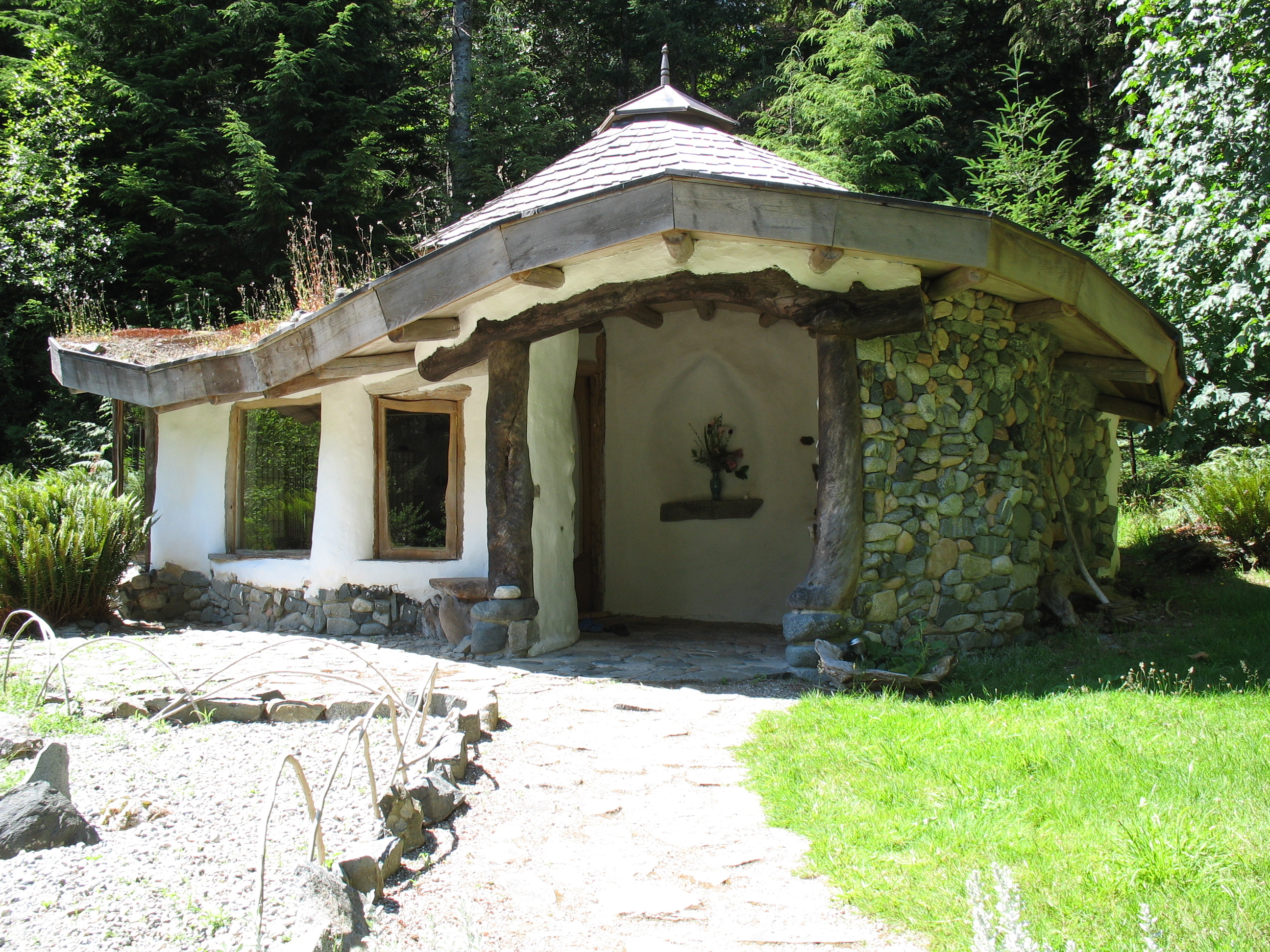
The use of stone in the outer walls, preferably the double stone with a gravel inter lay that is commonly used in the Hebridean black houses would improve both the drainage and the longevity of the standard wooden framed earth lodge.
Adding a similar stone floor would reduce water that could collect there and would also allow for cob to be used on the inner walls. Cob, a natural earth type cement that is tremendously strong when dry, but susceptible to water damage would not be suited to the outer walls of a partially submerged home, but its strong load bearing ability and longevity when dry could be safely used as inner walls, with stone at the base and the top to act as a water barrier.


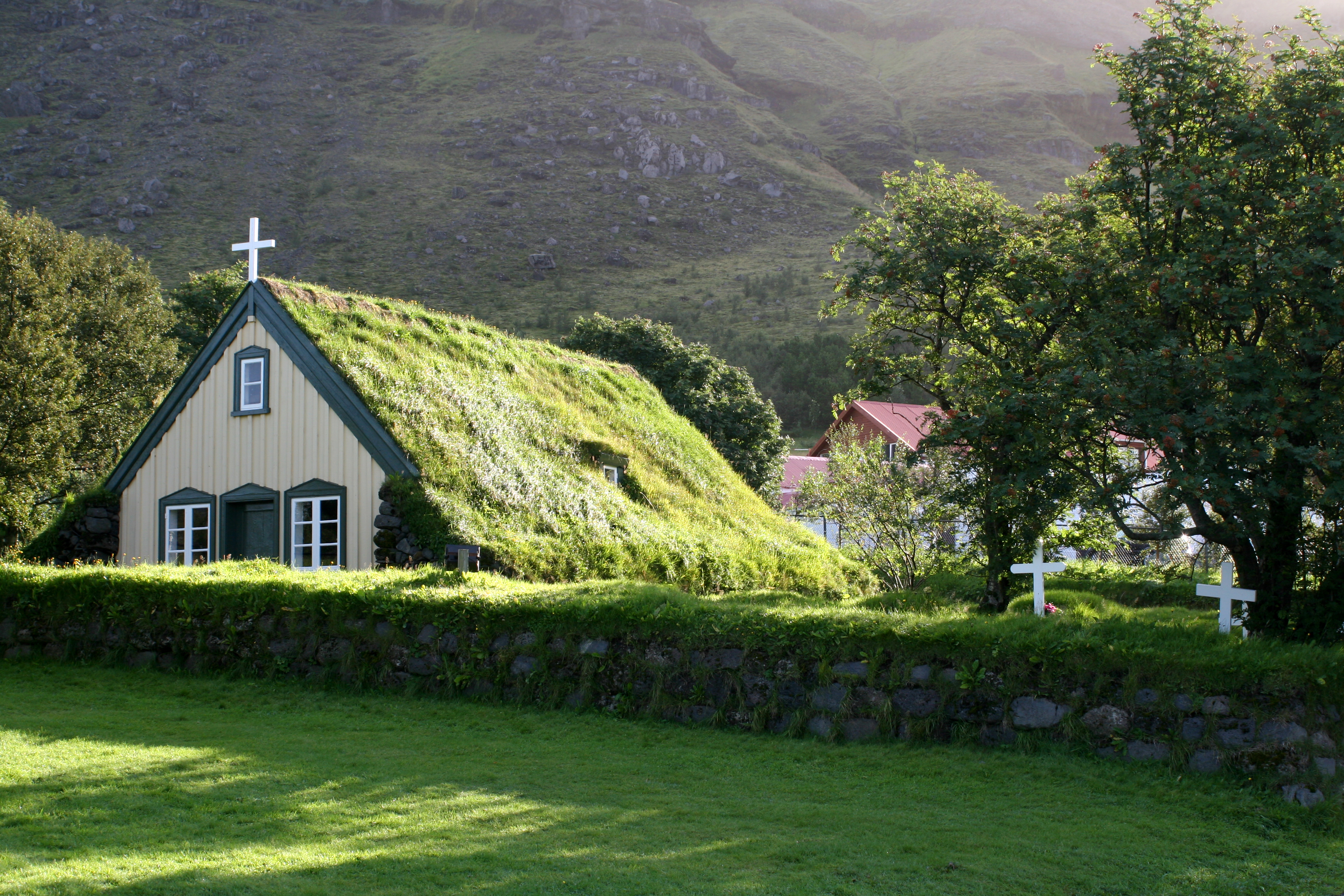 This leaves the roof as the point of contention. If modern waterproofing with plastic or another impermeable substance in unavailable, then the roof will likely be the most temporary part of the dwelling, and will need to be replaced on a semi-regular basis. The thickness of the roof will be a critical factor in keeping dry with materials that are not waterproof. Although the Scandanavians used birchbark underneath a grass covered sod roof to achieve impressive water proofing with a 30 year lifespan on the roof.
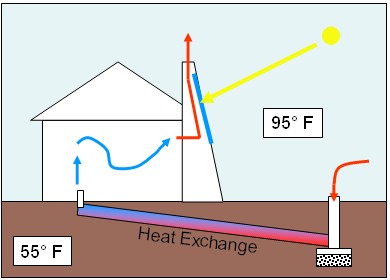
To deal with the ventilation and air quality a builder can add a solar chimney or similar passive heat exchange system that uses temperature change to drive air flow. This would also allow for more traditional materials to be used, since electricity or other active energy would not need to be added to the system for the system to function.
Finally, how to address the lighting problem? South facing windows will catch the most natural light. White walls will defuse the light more evenly throughout the room. Reflective surfaces will bounce the light, allowing for more defusion at other points in the room. Light tubes can be added to good effect. After that the best option is going to be some sort of lantern variation.

Wednesday, September 17, 2014
Clothing design for Homesteads and Small Tribes
Material
 Leather will likely be the word of the day. Sturdy and workable into both clothing and armor, leather is easily available through hunting most wild game in British Columbia. Plant fibers are significantly more difficult to cultivate and most, like cotton, need warmer climates than we can provide. Cedar bark can be woven into certain garments, such as hats in the style of the Haida and Salish tribes.
 Animal fibers are more easily cultivated in this climate, but sheep generally only provide wool and no other essentials of life besides meat when they are finally butchered. Sheep produce milk, but this is rarely drunk, although it makes excellent cheese. Goats can produce cashmere- which is labor intensive and low yield although very soft- and angora with grows quickly and is easily harvested. Goats can also be used for dairy purposes and for meat at the end of life, and also for land clearing purposes. Angora rabbits will also produce angora fibers, but in smaller amounts than angora goats and they do not provide dairy and have no land clearing ability.

Thus the plan for clothing materials is as follows:
- Leather and fur from hunted game ranging from deer, elk and moose to rabbits, hares, beavers and similar.
- Goatskin and Angora fiber from Goats. We will keep a mix of fiber and dairy goats.
- Cedar bark strips from Cedar trees, spruce roots- and Cattails can also be used. These are used for hat weaving,
- Scavenged metal and hard plastic, these will be used for body armor.
- Greenery and dry vegetation will be used for Ghillie cloaks.
- Wax to waterproof hats and shoulder pads will come from bees kept by tribe.

Fashion Sense
Hats: We suggest stealing the hat design from the Haida, bark woven conical hats that will shed water well in the Rainy coastal weather, probably coated in beeswax to enhance the waterproofing. You may also employ a helmet version crafted out of water hardened leather as well.
Cloaks: We also suggest using cloaks, probably shoulder pads made of leather or fur to help shed water in the rain. In addition to a simple cloak for protection from cold and rain, we recommend using a Ghillie cloak covered in local flora as a hunting and war camoflage

Pants: Leather pants, probably wrap pants held in place with a leather thong, or native america style chaps will be the common type of leg covering.
Shirts: Shirt should be loose leather tops with water hardened leather plate brigandine over them in the summer, and angora and fur over shirts in the winter.
Shoes: Mocassins ought be the most common footwear, with furs added for winter wear.
Coats: Overcoats can be made of various materials based on needs and availability.

Kilts and Skirts and Dresses: Kilts and Skirts and Dresses are possible during warmer summer months for cooling purposes. Various materials will be used for these.
Sunday, September 14, 2014
A Quick Peak at a Grubenhaus
-From Wikipedia, the Free Encyclopedia
A Grubenhaus (pl. Grubenhäuser compounded from the German Grube [pit or cavity] and Haus [house]) is a type of sunken floored building built in many parts of northern Europe between the 5th and 12th centuries AD. In the United Kingdom, they are sometimes also known as 'grubhuts' or 'grubhouses'.

Yet another earth sheltered home design used by people elsewhere in the world. A design this popular must have something going for it.
Saturday, September 13, 2014
Wednesday, September 10, 2014
Idea: The Inverse Motte and Bailey Castle
The traditional Motte and Bailey castle is basically just a hill of earth (the motte) and a wooden castle surrounded by a timber wall around the castle (the bailey). The weakness of this design is that invaders can literally just run up the hill. And additionally, the bailey is the highest point on the landscape and therefore a tempting target to anyone who is looking for a target.
My suggestion as an alternative idea is what I call, the inverse Motte and Bailey.
The motte is a ring around the bailey, with a sharp vertical edge on the outside wall with large stones to support the motte. The inside edge of the motte should taper gently down so the defenders could easily run up the hill to defend the walls. Additionally, a trench or moat could easily be added and filled with thorn bushes such as blackberries, and surrounded by quick growing trees to hide the settlement from outside view.
The bailey, instead of being the focus of the whole setup, disappears in the Inverse Motte and Bailey. Instead of a tall bailey rising up above the rest of the landscape, the settlement should be low profile with sod roofing so that even from the air, the settlement disappears into the landscape.
Whereas the original Motte and Bailey was designed to be a tenth century stronghold for a warlord who intended it to command respect. The Inverse Motte and Bailey is intended to vanish from view and disappear into the landscape. The original is a statement of domination and power. The inverse is a whisper on the land designed to meld with the land and vanish into the place itself.
With the intended goal of disappearing, access to settlement creates a challenge, allowing for easy access to the settlement for those with permission to enter and access for those goods and services brought in from outside the settlement. Can a moose or bear brought down in a hunt be brought into the settlement? If larger goods are being brought in, logs and rock for construction as an example, can these be brought easily into the settlement.
Large doors invite attack. Is there a way to hide them, perhaps behind hanging moss or some other camouflage, or perhaps behind an antechamber of earth walls much like the curve in a public washroom that hides the room without closing access? Perhaps creating a tunnel through the wall that can be more easily blocked and hidden than a large set of castle style walls.
If there is trade taking place, can that trade be redirected to a trading post that is not near the settlement? Do food or crops needs to be brought in from outside the the wall? Can these crops be moved so that they are planted within the walls?
Can access be achieved covertly, perhaps through a concealed water access way? Can access be achieved easily without sacrificing security? Can defense be achieved without drawing attention to the settlement?
Since the settlement will be using earth sheltering, can the motte itself be uses as a building, perhaps barracks or cold cellars or other public buildings? The idea of building rooms into the walls that defend the people suggests symbolic meaning in whatever purpose the rooms in the motte are used.
Also important to consider is drainage, because the motte creates a basin. Without proper drainage, the bailey will drown in the center of the motte after heavy rain. These small technical problems must be addressed, otherwise the grand idea doesn't stand for much. The devil's in the details.
Sunday, September 7, 2014
On the Dangers of Complexity
Parallel processing, meaning the ability of a computer (or a human brain) to perform multiple actions at the same time, is the litmus test of a processor's power. This draws attention to a major danger. Increasing complexity requires increasing processing power- and currently the human brain is not upgradable.
This means that the capabilities of our tools is now vastly superior to our ability to keep them all straight in our minds. We are leaving broken fossils of our virtual selves all across the Internet and in a multitude of company records. Our own personal virtual network of programs and sub-routines engaged on our behalf is beyond the ability of brains to manage.
We carry notes books full of passwords, because we aren't supposed to reuse them. Everyone needs a filing cabinet now, because the age of paper just keeps stacking up.
We are disappearing within our own abstract organizational structures.
To quote Tyler Dirden, "The things you own, end up owning you."
We end up over stimulated and in need of mind numbing entertainment in order to function. Stimulate and then sedate, rinse then lather and repeat.
Transhumanism tells us we need to upgrade ourselves in order to keep up. The Amish suggest a slower response. The rest of us are caught somewhere in the middle, with the bleeding edge driving complexity forward as we flounder to keep on top of all the changes.
Every time a new petition appears complaining about the new Facebook layout is a cry for help. People like to understand the world that they live in. Every time the ground moves under their feet, the become novices, helpless against the world once more. The increasing complexity coupled with arbitrary change and supposed progress is destroying our ability to cope with the world we live in. And so we post impotent Facebook petitions and rant on blogs nobody reads.
We need to walk away and re-take the real world, the one we can effect with our hands. We need to get dirty again. The real world can be learned over a life time, and changes in that real world follow understandable rules. The concept of a 'game changer' is very rare in the real world.
The horse and buggy still works just fine.
Friday, April 9, 2010
Editorial: The Souls of White Folk?
This title may have offended you. That was my intent. We are used to thinking about soul of Black people or Native Americans , or Meso-Americans or Asian peoples
 . It sounds somewhat blasphemous to talk about the souls of White Folk.
We are the villain- repression and conquest personified. To be a white person today is to lay claim to the spoils and crimes of generations of white people who came before. So I think this question is very relevant? What happened to the souls of white folk? Where did those souls go?
The African born slave could dream of returning to Africa. And in that dream there was a connection to an identity- a soul that gave him or her purpose and meaning and validation. An American born African-American can still look to the heritage of that past in Africa. And if that identity is too distant, the modern African-American can find identity in the struggle to be free. Where can white folk turn for an affirming identity that gives them strength and morality?
There is not a square inch of North America that is not occupied land. Every patch of earth is testimony to the crimes of white folk. Every shopping mall or high rise is a tombstone to murdered Native Americans and raped eco-systems. There is nowhere in North America that does not call out to the white person and call them a monster and murderer and betrayer and rapist. What about Europe? There is not a plot of land that is not stained with the blood of women and children. There is no arable land that has not been fought over by kings and conquerors, despots and tyrants and raiders and bandits and butchers. Nowhere is there not an unmarked grave from some injustice. On both continents, the landscape itself indicts the white person for crimes against life itself.
So where can the white person reclaim the soul lost so long ago? Are we doomed to be villains and monsters forever? People better hope not, because if the white folk don't find their soul and reclaim a collective identity that is positive- the world won't survive for much longer.
, or Meso-Americans or Asian peoples. It sounds somewhat blasphemous to talk about the souls of White Folk.We are the villain- repression and conquest personified. To be a white person today is to lay claim to the spoils and crimes of generations of white people who came before. So I think this question is very relevant? What happened to the souls of white folk? Where did those souls go?
The African born slave could dream of returning to Africa. And in that dream there was a connection to an identity- a soul that gave him or her purpose and meaning and validation. An American born African-American can still look to the heritage of that past in Africa. And if that identity is too distant, the modern African-American can find identity in the struggle to be free. Where can white folk turn for an affirming identity that gives them strength and morality?
There is not a square inch of North America that is not occupied land. Every patch of earth is testimony to the crimes of white folk. Every shopping mall or high rise is a tombstone to murdered Native Americans and raped eco-systems. There is nowhere in North America that does not call out to the white person and call them a monster and murderer and betrayer and rapist. What about Europe? There is not a plot of land that is not stained with the blood of women and children. There is no arable land that has not been fought over by kings and conquerors, despots and tyrants and raiders and bandits and butchers. Nowhere is there not an unmarked grave from some injustice. On both continents, the landscape itself indicts the white person for crimes against life itself.
So where can the white person reclaim the soul lost so long ago? Are we doomed to be villains and monsters forever? People better hope not, because if the white folk don't find their soul and reclaim a collective identity that is positive- the world won't survive for much longer.
Subscribe to:
Posts (Atom)